
-
Whatsapp 99 11 13 72 77
-
Email contact@thymedental.com
-
Call us 0124-4810777
Whatsapp 99 11 13 72 77
Email contact@thymedental.com
Call us 0124-4810777
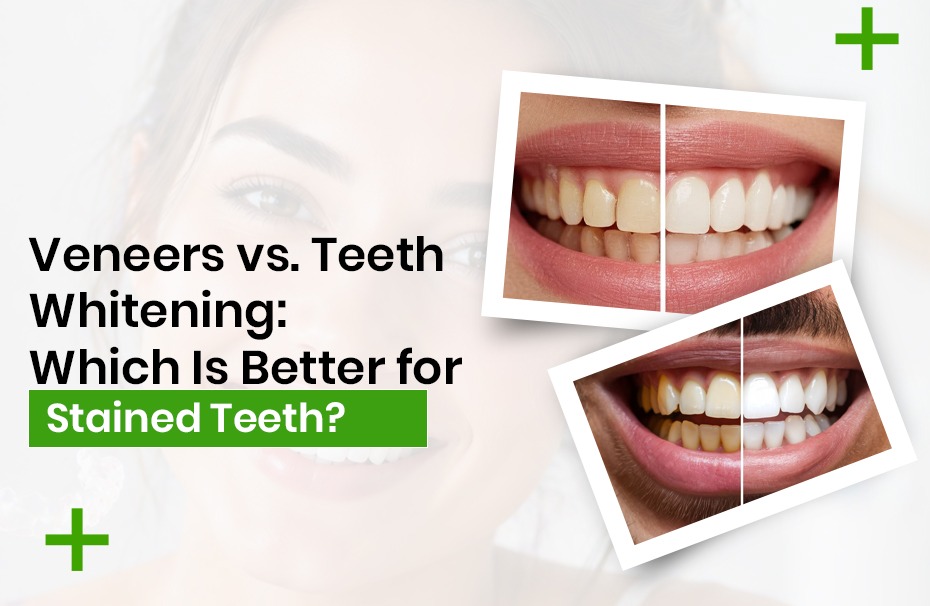
A bright, radiant smile is one of the most powerful aspects of personal confidence. However, over time, noticeability changes. Whether it is due to dietary habits, aging, or underlying structural variations, tooth discoloration affects almost everyone.
The two main cosmetic dentistry treatment options for making your stained teeth look brighter are professional teeth whitening or dental veneers. Both treatments will produce fantastic results; however, they can also be used separately to address two distinct types of tooth stains.
When you are deciding what option is right for you, it is important first to understand the type of dental stain you have, along with the current health of your enamel, as well as the biological differences between surface stains and deep staining, which may cause underlying damage to the structure of your teeth.
Before choosing a cosmetic pathway, the stain must be diagnosed by its origin. Stains are divided into two distinct categories: extrinsic (surface-level) and intrinsic (deep or internal).
Extrinsic stains have built up over time onto the external layer of the tooth, the enamel; these are most commonly a result of the following:
● Drinking beverages like coffee, tea, or red wine daily.
● Eating heavily pigmented foods and habits like smoking and/or chewing tobacco.
● Natural; due to natural plaque composition, it has built up over time against the teeth.
Intrinsic stains occur within the inner structure of the tooth, known as the dentin. These stains cannot be reached by typical surface treatments because they are embedded within the tooth matrix itself. Common causes include:
● Antibiotic use (such as tetracycline) during early tooth development.
● Trauma or root canal issues that darken the tooth from the inside.
● Fluorosis: A condition caused by excessive fluoride intake during childhood, which disrupts enamel formation and leaves teeth with a distinctive, mottled, or “flaky” appearance.
If a clinical evaluation shows that your discoloration is purely extrinsic, professional teeth whitening is the ideal, conservative method to brighten your smile.
At Thyme Dental, we start every teeth whitening procedure with a full, professional dental clean and polish. This step is really important because if you’ve got plaque or tartar on the surface of your teeth, it will prevent the bleaching gel from penetrating through those layers to reach your enamel. Performing a clean, it allows the enamel to be 100% free of debris/contamination so that the whitening agent can make direct contact with your tooth structure.
Once the tooth surface has been adequately prepared, we apply a professional strength, medically approved bleaching agent directly onto your teeth while being closely supervised. The active whitening ingredients can now penetrate through the porous enamel structure and break the chemical bonds between the surface stains (i.e., discolored pigments). This process is done safely and quickly in one visit and will result in immediate uniform brightness while not affecting your teeth’s shape or structure.
Traditional whitening techniques will not be effective for intrinsic stains because they contain bleaching agents and cannot penetrate an enamel layer that is damaged or of poor quality, particularly in cases involving fluorosis.
Fluorosis is not simply a cosmetic issue: it also alters the physical properties of the surface of the tooth, creating a flaky (or pitted), porous (or soft), and chalk-like look to the enamel. As a result, the underlying structure of tooth enamel is weakened; thus, the entire tooth is much more likely to accumulate bacteria. As a result, over time, teeth that have been impacted by fluorosis will naturally experience decay, which will result in cavities and structural breakdown if left without protection.
For intrinsic staining and fluorosis, dental veneers are the preferred clinical intervention. A veneer is an ultra-thin, custom-crafted shell typically made of high-quality porcelain or composite material that is permanently bonded to the front surface of the tooth.
The procedure is highly precise:
| Feature | Professional Teeth Whitening | Dental Veneers |
| Primary Indication | Surface-level, extrinsic stains (coffee, tea, aging) | Deep, intrinsic stains, fluorosis, structural defects |
| Enamel Alteration | None; completely non-invasive | Minimal reduction (0.2 to 0.3 mm of tooth structure) |
| Treatment Speed | Fast; typically achieved in a single office visit | Requires planning and custom placement |
| Stain Resistance | Teeth can re-stain over time with diet | High-grade materials are permanently stain-resistant |
| Structural Benefits | Brightens color only | Protects weak enamel from decay and prevents cavities |
The answer to whether veneers or whitening is better is based on an evaluation of your enamel’s current condition.
If your teeth are healthy and simply darkened due to everyday living (for example, coffee or tobacco products), then having a professional cleaning and polishing followed by a session of whitening will result in the quickest way to a bright, shiny, new-looking smile. If you have a structural type of stain that is either deeply set or is coupled with a flaky type of enamel due to something like fluorosis, then the only way you will achieve a permanent solution is by using veneers. Veneers not only cover and hide discoloration (i.e., yellowing of teeth), but they also protect your teeth from future decay and provide you with a permanent, bright, healthy-looking smile.
Contact us to schedule a complimentary consultation with one of our experienced cosmetic dentists in Gurgaon at Thyme Dental. Together, we will develop an individualized treatment plan that maintains your oral health while providing you with renewed self-esteem.

Dr Alka brings with her many years of rich experience in the field of dentistry. The idea of starting Thyme Dental was to provide world class treatment to her patients at an affordable price. Since the time of graduating from BRS Dental College, Panchkula in 2005, she has been an active clinician having worked with corporate setups, government hospital and super specialty hospitals..
Read MoreConveniently located in Mega Mall, DLF Phase I, Golf Course Road, Gurgaon, we offer world class dental treatment in an aesthetically designed modern dental clinic, where PATIENT CARE and QUALITY are given utmost importance. We take pride in letting our patients know that their safety is of utmost importance to us, and thus, we follow strict aseptic and barrier techniques.
Read More