
-
Whatsapp 99 11 13 72 77
-
Email contact@thymedental.com
-
Call us 0124-4810777
Whatsapp 99 11 13 72 77
Email contact@thymedental.com
Call us 0124-4810777
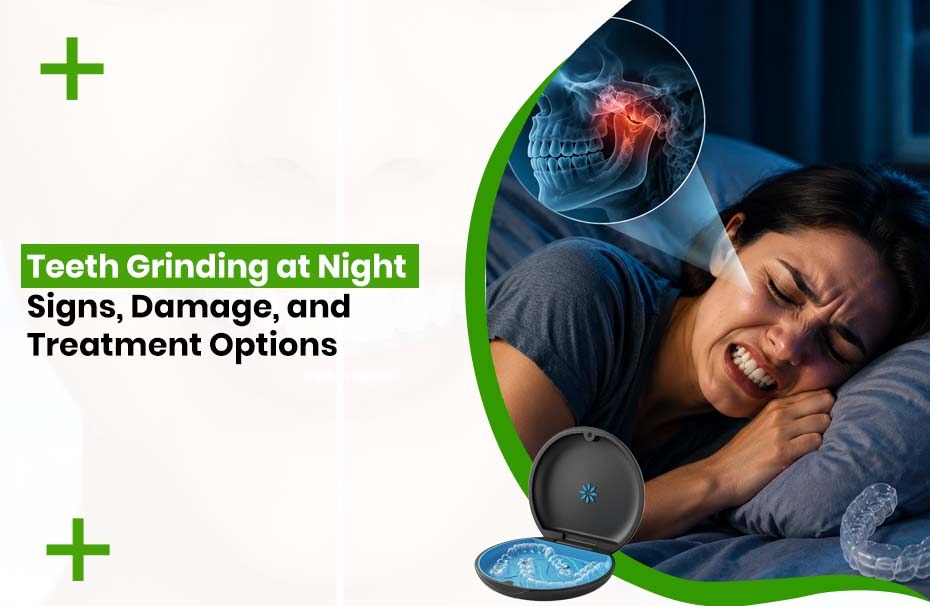
Waking up with a dull headache, a sore jaw, or unexplained tooth sensitivity are experiences many people brush off as signs of a poor night’s sleep or daily stress. However, these symptoms frequently point to a highly prevalent nocturnal condition known clinically as bruxism, more commonly referred to as teeth grinding at night.
Because bruxism occurs predominantly while a person is asleep, it often goes unnoticed for years. Left unmanaged, the continuous, heavy forces exerted during sleep can cause profound, irreversible damage to the teeth, jaw joints, and surrounding facial muscles.
Understanding the root biological causes of teeth grinding, recognizing the silent signs of dental wear, and exploring professional intervention pathways can protect your oral health from this destructive habit.
Teeth grinding, as defined from a clinical perspective, is very seldom a standalone, isolated dental disease. Rather, it is the result or expression of another problem: a symptom indicating a deeper structural, psychological, or developmental cause. Therefore, it is imperative for a dentist to identify and treat the cause of teeth grinding before attacking the habit; in most cases, the causes can be placed into one of three categories.
One of the most basic structural causes for daytime and nighttime teeth grinding is an abnormal bite (malocclusion). When the upper and lower jaws do not contact each other evenly or fit together smoothly, there is a disharmony in the structure of the two. During sleep, the muscles of the jaw will automatically try to grind away any “high points” (or interferences) on the teeth so that they are comfortable and can rest in the most natural position. The result of this excessive friction is the appearance of excessive (unneeded) teeth grinding.
For most adults suffering from bruxism, it is almost invariably linked with stress, anxiety, and pressure associated with work. When the brain’s central nervous system is kept highly activated throughout the day by excessive stress levels, it will tend to move to discharge the stress and tension that builds up during the day in the form of powerful contractions of the jaw and chewing muscles while sleeping.
Many cases of night grinding are classified as idiopathic, occurring spontaneously with no obvious physical cause. Psychogenic grinding, or psychological grinding, is sometimes confused with an idiopathic cause. There are many pathways through which these types of grinding occur, which may be related to disturbed sleep architecture and/or neurological pathways. In this case, a patient’s teeth could be in a normally aligned position according to the dentist’s examination, but they may exhibit frequent, involuntary, repetitive grinding patterns when they sleep.
The overall appearance of your teeth grinding will not change; however, the reasons you have for this habit vary greatly depending on the age group you belong to.
● Children-Some children (especially young children and toddlers) grind their teeth while they sleep. Pediatric patients tend to have this habit due to growth and development, specifically because of the constant changes that occur as a child goes through mixed dentition (the process of getting rid of baby teeth and getting new adult teeth) and how they fit together, from losing baby teeth to bringing in new adult teeth. As the child’s occlusion develops and stabilizes, many children will stop the grinding, and it is very important to have an early dental assessment at a dental clinic in Gurgaon to avoid locking a developing malocclusion into place.
● Adults typically have a more permanent and destructive form of bruxism. An adult has fully developed bone and enamel (the hard outer covering of the teeth); their jaw muscles (by the time the individual is an adult) can create as much as 250 lbs. of pressure per square inch of grinding force. This pressure is the result of no longer having the flexibility of a growing jaw; thus, the structure of the adult’s teeth has a very short time before the structure has suffered a great deal of wear.
People usually do not realize they are grinding their teeth at night because it happens unconsciously until they are told by a partner that they have heard loud clicking or grating noises. However, there are definite physical signs of this type of behaviour on the mouth:
Managing teeth grinding requires a multi-faceted clinical approach that rules out structural anomalies before implementing protective maintenance protocols.
The first mandatory step in addressing bruxism is a comprehensive evaluation by your dentist to rule out alignment discrepancies. If a developing malocclusion or improper tooth positioning is identified as the root trigger, orthodontic alignment correction must be prioritised. Straightening the teeth and balancing the bite removes the structural interferences, allowing the jaw muscles to relax and effectively stopping the biological drive to grind.
Read More: Invisalign aligners in Gurgaon for correcting bite alignment and improving overall dental function.
If alignment issues are completely ruled out and the bruxism is deemed stress-related or idiopathic, the objective shifts from elimination to structural protection. This is achieved using a professional night guard, a custom-made oral appliance worn comfortably during sleep. The guard serves as a protective barrier, absorbing the immense forces of mastication so that the dental porcelain or natural enamel does not wear away.
People usually do not realize they are grinding their teeth at night because it happens unconsciously until they are told by a partner that they have heard loud clicking or grating noises. However, there are definite physical signs of this type of behaviour on the mouth:
Grinding your teeth is a habit that can cause damage to your teeth over time and may occur without you knowing about it. The reason could be that your teeth do not line up correctly; there is stress in your life, or maybe your jaw developed this way when you were young. It is important to treat the problem quickly before enamel is damaged and you end up with chronic pain in your jaw.
At Thyme Dental, our experienced dentist in Gurgaon uses the latest 3D digital scanning technology to get an accurate diagnosis of any misalignment in your teeth and produce a custom night guard to fit your exact jaw so that you will not damage your natural teeth due to the grinding effect of bruxism. We invite you to schedule a full consultation with our trained staff to find out why you are grinding your teeth and how you can regain some peace while sleeping.

Dr Alka brings with her many years of rich experience in the field of dentistry. The idea of starting Thyme Dental was to provide world class treatment to her patients at an affordable price. Since the time of graduating from BRS Dental College, Panchkula in 2005, she has been an active clinician having worked with corporate setups, government hospital and super specialty hospitals..
Read MoreConveniently located in Mega Mall, DLF Phase I, Golf Course Road, Gurgaon, we offer world class dental treatment in an aesthetically designed modern dental clinic, where PATIENT CARE and QUALITY are given utmost importance. We take pride in letting our patients know that their safety is of utmost importance to us, and thus, we follow strict aseptic and barrier techniques.
Read More