
-
Whatsapp 99 11 13 72 77
-
Email contact@thymedental.com
-
Call us 0124-4810777
Whatsapp 99 11 13 72 77
Email contact@thymedental.com
Call us 0124-4810777
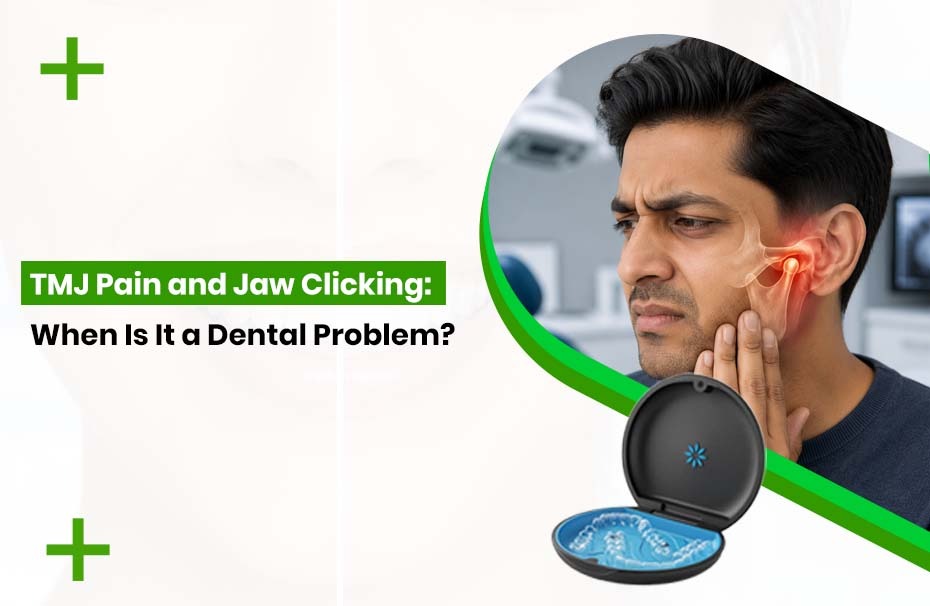
Have you ever noticed a distinct clicking or popping sound in your jaw while chewing a meal, yawning, or simply talking? Or perhaps you have woken up with a dull, radiating ache near your ears that stretches down into your neck? These symptoms are classic indicators of tension within the temporomandibular joint, widely known as the TMJ.
Because jaw pain and clicking can feel structural or muscular, many individuals are unsure who to consult. They often wonder: When is TMJ pain actually a dental problem?
From a clinical perspective, your bite mechanics and jaw joint health are fundamentally inseparable. The TMJ does not operate in isolation; it is directly guided by how your teeth come together.
Understanding the structural anatomy of this hard-working joint, its connection to sleep behaviors, and modern diagnostic protocols can help you determine when jaw discomfort warrants a visit to a specialized dentist in Gurgaon.
To understand why the TMJ (temporomandibular joint) is prone to pain and structural breakdown, we need to understand its unique structures and the mechanical work it does every day.
The TMJ is a complex structural hinge between your mandible (lower jaw) and the rest of your skull. It is a high-activity (bilateral) joint; therefore, the left and right TMJ must function in perfect synchrony.
Think of everything you do every day: from the moment you wake up, you are using this joint; whether you are talking, swallowing, drinking, chewing, or yawning, you are using it continuously throughout the day. Therefore, the TMJ may be the most overused joint in the entire human body.
Within the joint capsule is a unique fibrocartilaginous disc; every time you open your mouth, the disc provides cushioning for the mandible as it glides forward without resistance.
Similar to your knees and hips, this disc can break down due to normal wear and tear as you age, but given normal use, the joint can accommodate that amount of use. It is only when additional uneven forces are introduced to the system that it causes the system to be subjected to pathological loading.
After a patient comes into the clinic with a clicking jaw or localized TMJ discomfort, the first thing to do clinically is to perform an in-depth intraoral examination. The dentist will specifically examine the occlusion (how the upper teeth sit against the lower teeth when they bite down).
A misaligned bite can affect how your TMJ feels and wear it out. Abnormal bites cause the jaw muscles to perform greater efforts to move the teeth together to eat properly. This creates unequal force distribution across the arch and can create a lot of stress on your TMJ.
This continuing trauma can place your disc out of alignment. The clicking or popping of your jaw is the result of the disc coming out of alignment, either because the disc has been displaced when you open your mouth too wide or it snaps back into its normal location after doing so. If this is a structural alignment issue, over time, the clicking or popping of the jaw may become chronic inflammation, muscle spasms, and extreme pain, i.e., much more than you would experience.
Recent research in dentistry has revealed an interesting relationship between TMJ problems (temporomandibular joint) and nighttime teeth grinding (bruxism) – both are closely linked and create a never-ending cycle of harm to the body.
THE BRUXISM-TMJ CYCLE
└────────────────────────────┘
Chronic Nocturnal Grinding
│
▼
TMJ Deprived of Essential Night Rest
│
▼
Accelerated Disc Wear & Tear
│
▼
Morning Jaw Stiffness & Pain
│
▼
Bite Instability & Muscle Spasms
The jaw joint is constantly in use during the day. The only time the TMJ was biologically designed to rest, recuperate, and heal was during the night while sleeping (the only time the TMJ was intended to have the opportunity to take a vacation). If a person is grinding their teeth at night due to psychological stress, work-related tension, an imbalance in their bite, or other issues, they are depriving the jaw joint of the necessary time off it needs to heal, recover, and restore itself. As a result, they will be working against an increasing amount of resistance to their teeth for hours while they sleep.
When they wake up, they will have extremely painful facial muscles (muscle rigidity) and/or will be experiencing TMJ pain due to the impact their teeth have been having on one another without the TMJ having had the opportunity to rest, recover, and restore itself. Because of the grinding of their teeth, the TMJ cartilage is subjected to accelerated wear-and-tear relative to individuals who do not have this issue overall.
If a person has some underlying TMJ disorder, a dentist should assess them for a potential tooth grinding issue, as the tooth grinding can also cause damage to the temporomandibular joints if left untreated.
The most important factor in stopping the cycle of TMJ joint destruction before it leads to permanent structural damage is an accurate diagnosis. Although standard dental X-rays (such as OPGs) can exclude large bone fractures or substantial, advanced joint destruction, their limited visibility does not allow for the evaluation of TMJ joint problems that may arise during early stages of degeneration.
The modern clinical standard for the diagnosis of complex TMJ disorders is the use of MRI.
Unlike traditional X-ray films, which only display bone structures, MRI provides a three-dimensional view of the entire TMJ joint complex. This enables the clinician to obtain a clear, highly accurate picture of the soft tissues surrounding the TMJ joint, specifically how the soft tissue/cartilage disc is positioned, how it is functioning, and how it is moving. MRI allows the clinician to accurately assess the extent of wear and tear on the disc and whether or not there is active displacement of the disc while the jaw is in motion, leading to the development of a highly specific treatment plan.
Depending on the stage of joint degradation, TMJ management scales from simple behavioural changes to cutting-edge clinical interventions.
If the patient has mild discomfort, then treatment should begin with conservative measures. These treatments should include:
● Medical Treatment – Try to use a short duration of anti-inflammatory medication (analgesics) to help reduce acute joint inflammation.
● Physiotherapy – There are specific and gentle jaw exercises that you can do to help stretch and strengthen the masticatory muscles and bring the jaw back to an equally centered position.
● Dietary Modifications – Refraining from eating hard, chewy, or crunchy foods will help to give the overused joint some time to rest.
● Support Protocols – Instructing the patient to consciously avoid opening their mouth too wide (for example, during yawning) and to assist their lower jaw by using their hand to support their jaw while doing so.
Patients with chronic TMJ pain or muscle spasms that do not respond to physical therapy may find relief through therapeutic Botox injections. This treatment has been well established in the field of modern dentistry as an innovative and reliable method of reducing joint pain.
The use of botulinum toxin A is also widely recognized in cosmetic and anti-aging procedures; however, the use of Botox for TMJ treatment requires three stages: first, the use of the substance to further relax overly stimulated chewing muscles around the TMJ joint; secondly, provide the patient with “immediate” relief of tension and pain around the region of the TMJ joint caused by involuntary muscle spasm and clenching/grinding forces; and thirdly, provide the patient with a window of 3-4 months (or enough time) of pain-free living while allowing the inflamed joint tissue to rest and recover.
Should the MRI and digital imaging demonstrate that an underlying malocclusion is responsible for the joint trauma, permanent stability will be needed. Orthodontic alignment will allow for the proper guiding of teeth into a stable, balanced, and harmonious position. This will provide complete elimination of the structural forces causing pressure on the TMJ, which in turn will disrupt the cycle of damage and help prevent further wear of the joint.
Read more about the best Invisalign aligner treatment in Gurgaon.
TMJ pain and jaw clicking are clear signs from your body that your oral mechanisms are out of alignment. By ignoring these symptoms or masking them temporarily, you allow the wear on your joints to continue until it has advanced to the point where you require invasive surgery to repair them.
At Thyme Dental, a trusted dental clinic in Gurgaon, we take a comprehensive assessment approach to TMJ health. Combined with advanced imaging, digital analysis of the bite, and cutting-edge therapeutic options, for example, targeted muscle relaxants and customized alignment therapy, we assess the TMJ pain at the biological source.
Don’t let daily jaw pain affect your quality of life. Schedule your specialized diagnostic consultation with an expert at Thyme Dental to restore balance, comfort, and longevity to your smile and jaw.
[Book Your TMJ Evaluation Today]

Dr Alka brings with her many years of rich experience in the field of dentistry. The idea of starting Thyme Dental was to provide world class treatment to her patients at an affordable price. Since the time of graduating from BRS Dental College, Panchkula in 2005, she has been an active clinician having worked with corporate setups, government hospital and super specialty hospitals..
Read MoreConveniently located in Mega Mall, DLF Phase I, Golf Course Road, Gurgaon, we offer world class dental treatment in an aesthetically designed modern dental clinic, where PATIENT CARE and QUALITY are given utmost importance. We take pride in letting our patients know that their safety is of utmost importance to us, and thus, we follow strict aseptic and barrier techniques.
Read More